Why Australia? Why so many?
Australia has the highest rate of melanoma in the world — roughly 17,000 new cases each year. The
combination of high UV index, predominantly fair skin in our European-descended population, and outdoor
lifestyle creates the perfect storm. The good news: we also have the world’s best skin cancer detection
and treatment infrastructure.
BCC vs SCC vs Melanoma — what’s the difference?
Basal Cell Carcinoma (BCC) is the most common (about 70% of all skin cancers).
Slow-growing, almost never spreads. Looks like a pearly bump or non-healing sore. Highly treatable.
Squamous Cell Carcinoma (SCC) is the second most common (about 25%). More aggressive
than BCC but still highly treatable when caught early. Looks like a thickened, scaly red patch or
wart-like growth. Melanoma (about 5%) is the most serious form — but caught early, it
has a 95%+ 5-year survival rate. Looks like an unusual or changing mole.
The ABCDE rule for moles you can check at home
A — Asymmetry: One half doesn’t match the other. B — Border: Edges
that are uneven, scalloped or notched. C — Colour: Multiple colours or uneven
distribution (browns, blacks, reds, blues). D — Diameter: Larger than 6mm (the size of
a pencil eraser). E — Evolving: Changing in size, shape, colour, elevation, or
developing new symptoms (bleeding, itching, crusting). Any of these warrants a GP visit.
What is dermatoscopy?
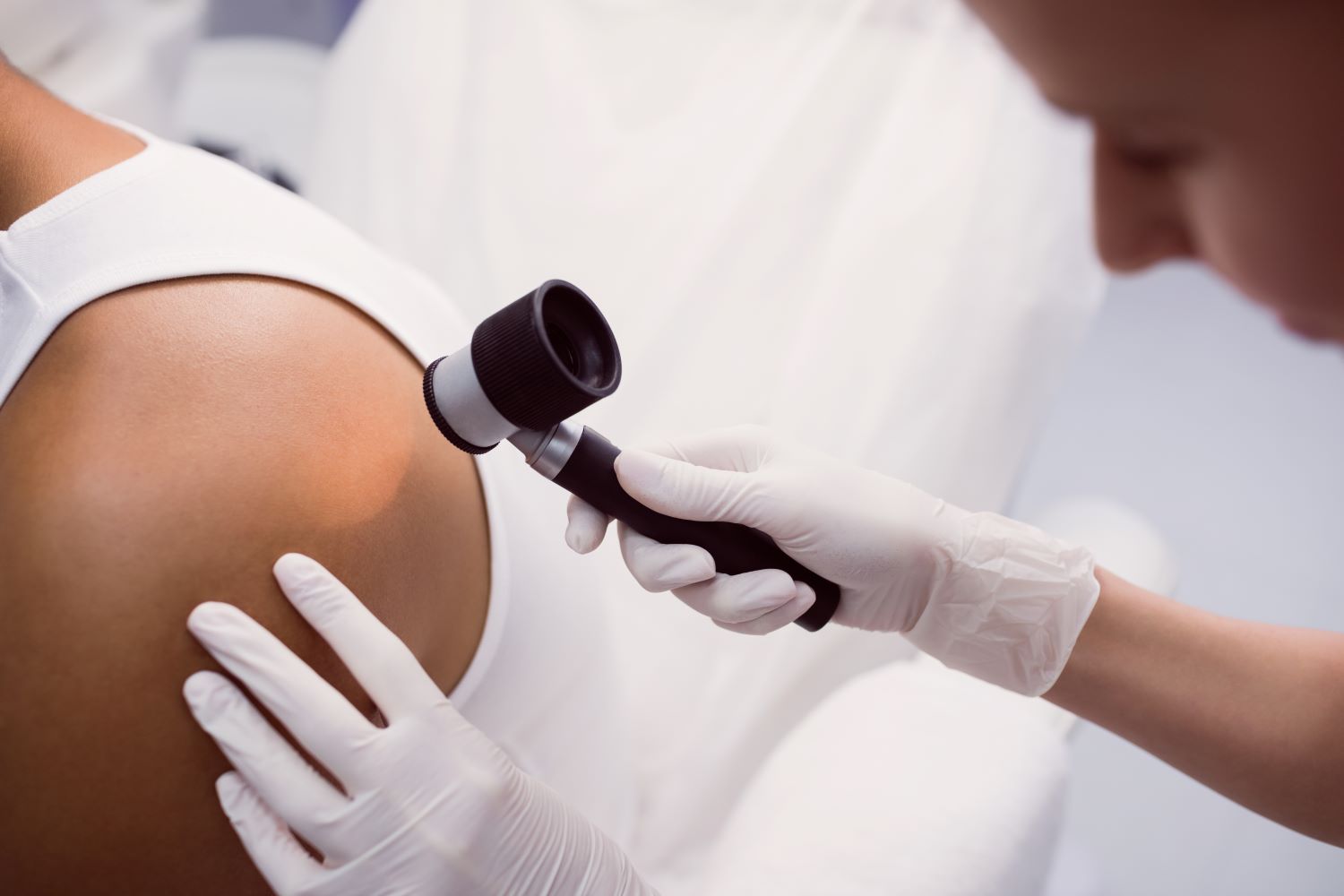
A dermatoscope is a magnified, polarised lens that lets a trained doctor see patterns inside the skin
that are invisible to the naked eye. It’s like looking at a normal photo vs an MRI of the same area —
the dermatoscope reveals the cellular architecture beneath. Modern dermatoscopy detects 90%+ of
melanomas, including some that look completely normal to the untrained eye.
How often should I be checked?
Low risk (light-skinned, no family history, low sun exposure): every 1–2 years from
age 20. Moderate risk (fair skin, occasional sunburns, some moles): annually from age
20. High risk (very fair skin, family history of melanoma, many moles, history of bad
sunburns, immunosuppressed): every 6 months. Anyone with a previous skin cancer needs ongoing
surveillance every 3–6 months.
What happens at a skin check?
Wear loose, easy-to-remove clothing. The doctor performs a head-to-toe examination — yes, including
unusual places (scalp, behind ears, between toes, groin). Dermatoscope is used on every suspicious
lesion. Photographs may be taken for mole mapping. Most check-ups take 20–30 minutes.
If something is found
Biopsy — a small sample taken under local anaesthetic, sent to pathology. Result in
5–7 days. Excision — if cancer is confirmed (or strongly suspected), the lesion is
removed under local anaesthetic on-site. Larger or facial excisions may need flap or graft repair for
cosmetic outcomes. Follow-up — schedule depends on the type and stage. Most early skin
cancers are completely treated by excision alone.
Sun protection — the best treatment is prevention
Slip on sun-protective clothing. Slop on SPF 30+ sunscreen, reapplying every 2 hours. Slap on a
wide-brimmed hat. Seek shade between 11am and 3pm. Slide on sunglasses. The Cancer Council’s “Slip,
Slop, Slap, Seek, Slide” message saves lives — but doesn’t replace annual checks.
? Key Takeaways
- Annual skin checks save lives — caught early, melanoma has 95%+ 5-year survival
- Use the ABCDE rule monthly at home
- Dermatoscopy finds skin cancers invisible to the naked eye
- Check-ups take 20–30 minutes, fully bulk-billed at Cranbourne West
- Sun protection is prevention; skin checks are early detection
- Higher-risk patients need 6-monthly surveillance
Related services at Cranbourne West Medical Centre
→ Skin Cancer Clinic
→ Minor Surgical Procedures
→ Preventive Health Assessments
Hub editorial team for general health information. It has been reviewed for accuracy but is not a
substitute for personal medical advice. Always consult your GP for individual health concerns.