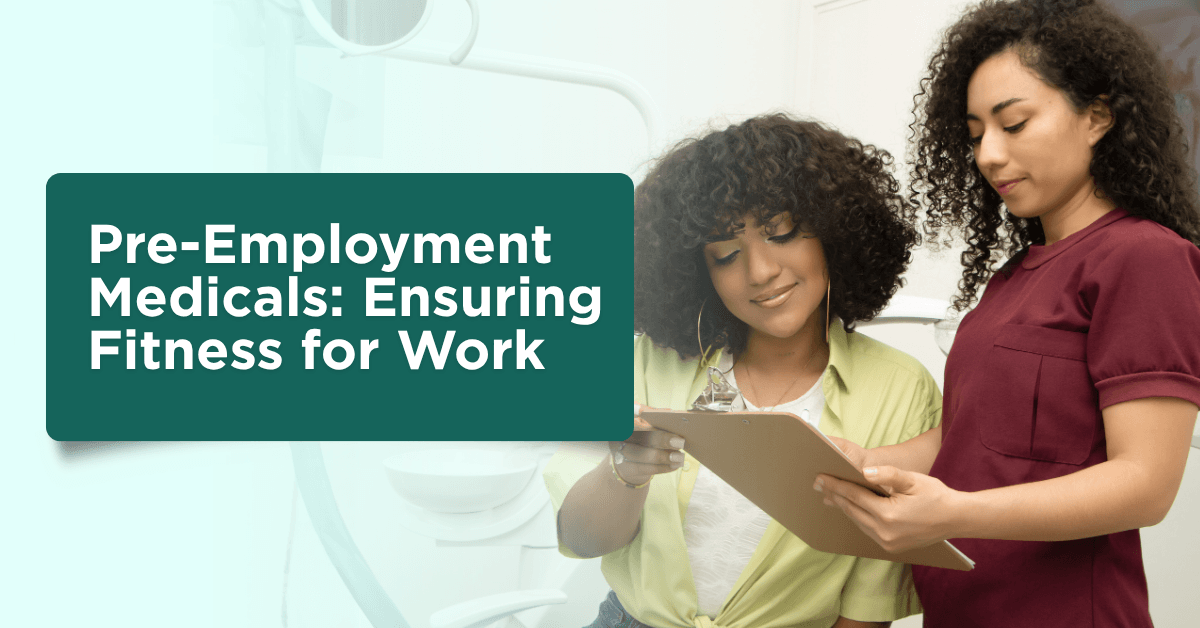
Hiring the right employee involves more than reviewing qualifications and experience.
For many industries, employers also need to consider whether a candidate can safely perform the inherent requirements of a role. This is where a pre-employment medical can play an important role.
Pre-employment medical assessments are commonly used across industries such as construction, manufacturing, transport, healthcare, mining, warehousing and other physically demanding workplaces.
They can help employers make informed decisions while supporting workplace health and safety.
If you have been asked to undergo a pre-employment medical or are an employer considering occupational health assessments, understanding the process can help clarify what is involved.
What Is a Pre-Employment Medical?
A pre-employment medical is a health assessment conducted before a person begins employment or before they are confirmed for a role.
The purpose is usually to assess whether an individual can safely perform the inherent requirements of the role being considered.
The assessment is not designed to exclude applicants unnecessarily. It helps identify health considerations that may be relevant to workplace safety, job demands and reasonable workplace planning.
A pre-employment medical Cranbourne West appointment may include a medical history review, physical examination, functional assessment, vision testing, hearing assessment, drug and alcohol screening or other role-specific checks depending on employer requirements.
Cranbourne West Medical Centre provides Private Medical Assessments and workplace-related medical services for patients and employers needing structured health assessments.
Why Are Pre-Employment Medicals Important?
Pre-employment screening can support both employers and employees.
For employers, a pre-employment medical may help support workplace health and safety, assess fitness for work requirements, identify potential workplace risks, check whether role-specific physical requirements can be met and support safer employment decisions.
For employees, the assessment may help identify health concerns that need review, ensure job duties are suitable for the individual’s capabilities, support workplace adjustments where appropriate and reduce the risk of preventable workplace injury.
The goal is not simply to pass or fail a candidate. The goal is to match health, safety and job requirements appropriately.
For local workers and employers, a pre-employment medical Cranbourne West appointment can provide practical assessment close to the workplace or home.
7 Things That May Be Included in a Pre-Employment Medical
The exact assessment varies depending on the employer, industry and position. A desk-based office role may require a different assessment from a heavy vehicle, warehouse, healthcare, construction or mining role.
1. Medical History Review
The doctor may ask questions about previous illnesses, medical conditions, surgeries, medications, allergies, workplace injuries, current symptoms and relevant health concerns.
This helps provide context for the assessment.
The purpose is not to collect unnecessary personal information. It is to understand whether any health factors may affect safe work performance for the specific role.
For example, a history of back injury may be relevant for a role involving repetitive lifting, while sleep apnoea risk may be relevant for safety-sensitive driving work.
Honest and accurate information helps the doctor provide a fairer assessment.
2. Physical Examination
A physical examination may include height, weight, blood pressure, heart rate, general physical health, mobility, movement, musculoskeletal function and relevant body systems depending on the role.
The specific examination should relate to the job requirements.
For physically demanding jobs, the doctor may assess whether there are any concerns that could affect lifting, bending, standing, walking, climbing or repetitive tasks.
For safety-sensitive work, the assessment may focus more on conditions that could affect alertness, coordination, cardiovascular health or safe task performance.
A pre-employment medical Cranbourne West appointment can be tailored to the role requirements provided by the employer.
3. Functional Capacity Assessment
For physically demanding positions, assessment may involve functional checks related to movement and work capacity.
This may include lifting capacity, flexibility, range of motion, grip strength, squatting, bending, reaching, balance, physical endurance and musculoskeletal function.
The goal is to evaluate whether the individual can safely perform essential work tasks.
Fitness for work is assessed in relation to the specific role, not in a general or vague way.
A person may be fit for one role but require adjustments, further assessment or extra consideration for another role with different physical demands.
4. Vision Testing
Many roles require adequate vision for safety and performance.
Vision assessment may include visual acuity, colour vision testing or peripheral vision assessment depending on the industry and role.
This can be especially important for transport, driving, machinery operation, electrical work, healthcare, emergency services and safety-sensitive tasks.
If you wear glasses or contact lenses, bring them to the appointment.
Cranbourne West Medical Centre also provides Driving Medicals for commercial drivers and other driver assessment requirements.
5. Hearing Assessment
Some workplaces expose employees to high levels of noise or require strong hearing awareness for safety.
Hearing assessments may be requested for roles where hearing capacity is relevant to workplace safety or communication.
This may be common in construction, manufacturing, mining, transport, warehousing and industrial settings.
If hearing concerns are identified, the next step may involve further assessment, workplace controls, hearing protection advice or role-specific recommendations.
6. Drug and Alcohol Screening
Some employers request drug and alcohol testing as part of their recruitment or workplace safety process.
This is more common in safety-sensitive industries where impairment could increase the risk of harm to the worker, colleagues or the public.
Testing requirements are determined by employer policy, workplace risk and relevant regulations.
Cranbourne West Medical Centre provides Urine Drug Screens for patients and workplaces requiring this type of assessment.
If a drug and alcohol screen is required, ask the employer or clinic what identification and paperwork you need to bring.
7. Respiratory or Role-Specific Testing
Occupations involving dust, chemicals, fumes or respiratory hazards may require lung function testing or additional health checks.
This can apply to construction, mining, manufacturing, industrial workplaces, healthcare, cleaning, agriculture and other environments with exposure risks.
Other role-specific checks may include ECG, pathology tests, urine testing, immunisation review, hearing tests, mask fit requirements or specialist referral depending on the job.
Cranbourne West Medical Centre provides Pathology and Blood Tests and ECG Tracings where clinically or occupationally appropriate.
What Is Fitness for Work?
Fitness for work refers to an individual’s capacity to perform the essential tasks of a role safely and effectively.
Fitness for work assessments consider physical capability, medical history, workplace demands, safety risks, role requirements and any relevant health conditions.
Importantly, fitness for work is assessed in relation to the specific job being performed.
A person may be fit for office-based duties but need further review for a role involving heavy lifting, commercial driving, confined spaces, shift work, heights or hazardous materials.
This is why the employer should provide clear information about the role and its inherent requirements.
A pre-employment medical Cranbourne West assessment is most useful when the doctor understands the actual duties involved.
What Is an Occupational Health Assessment?
An occupational health assessment evaluates how a person’s health relates to their ability to perform work duties.
Occupational health assessments may be conducted before employment, during employment, after injury, after illness, for return-to-work planning or for ongoing workplace monitoring.
The focus is workplace health, safety and functional capacity.
These assessments may help identify whether someone is fit for work, fit with recommendations, temporarily unfit, or requires further information before a decision can be made.
Occupational health is not only about employees. It also helps employers manage workplace risk responsibly.
Will I Pass or Fail a Pre-Employment Medical?
Many people worry about “passing” or “failing” a pre-employment medical.
In reality, the process is usually more nuanced.
The assessment considers whether an individual can safely perform the inherent requirements of the role.
Possible outcomes may include fit for work, fit with recommendations, further information required, temporary restriction, referral for additional assessment or not currently suitable for a specific role.
A medical condition does not automatically mean someone cannot work.
Many people with health conditions safely perform their duties with no issue or with reasonable adjustments.
The key question is whether the condition affects the specific role and workplace safety.
Common Industries That Require Pre-Employment Screening
Pre-employment medicals are commonly used in construction, transport and logistics, warehousing, mining, manufacturing, healthcare, emergency services, government sectors, aged care, disability support, cleaning, aviation, maritime, rail and utilities.
Different industries may require different types of assessment depending on workplace risks.
For example, a warehouse role may focus on lifting and musculoskeletal function. A driving role may focus on vision, cardiovascular health, sleep risk and medical fitness to drive. A healthcare role may involve immunisation review, infection risk and physical capacity.
A pre-employment medical Cranbourne West appointment should match the job, not use the same checklist for every worker.
How Should You Prepare for a Pre-Employment Medical?
Preparation is usually straightforward.
Bring photo identification, employer forms, job description if provided, glasses or contact lenses, a medication list, relevant medical reports, previous certificates and any requested pathology or screening paperwork.
Wear comfortable clothing, especially if physical movement or functional testing is required.
Avoid hiding important medical information. Accurate disclosure helps the doctor assess risk fairly and recommend appropriate steps.
If you are unsure what is required, check with your employer or healthcare provider before the appointment.
Confidentiality and Medical Information
Medical information obtained during an occupational health assessment must be handled carefully.
Employers generally need information relevant to workplace fitness requirements, not a full personal medical history.
The reporting process depends on the assessment type, consent, employer requirements, privacy obligations and applicable workplace policies.
A typical report may state whether the person is fit for the role, fit with restrictions or recommendations, or whether further information is required.
Workers should ask what information will be shared and who will receive the report before the assessment proceeds.
Employers should ensure medical information is collected only when relevant to the role and handled in line with privacy and anti-discrimination obligations.
What Employers Should Consider
Employers requesting pre-employment medicals should make sure the assessment is relevant to the role.
The medical provider should understand the inherent requirements of the position, physical demands, safety risks, required tasks and workplace environment.
Employers should avoid asking for unnecessary medical information that has no connection to the job.
They should also consider reasonable adjustments where appropriate.
Pre-employment screening works best when it supports safe hiring, fair decision-making and clear communication between employer, worker and medical provider.
What Employees Should Know
If you are asked to attend a pre-employment medical, it is normal to feel nervous.
The assessment is not meant to embarrass you or expose unrelated health information. It is designed to assess your capacity to perform a specific role safely.
You can ask what tests are included, why they are required, what information will be shared with the employer and whether results will be explained to you.
If you have a medical condition, bring relevant documentation if available. This can help the assessing doctor understand your current health status and work capacity more accurately.
Common Myths About Pre-Employment Medicals
Myth 1: Any Medical Condition Means You Will Not Get the Job
Many people with medical conditions safely perform their work duties. Assessments focus on role requirements and workplace safety.
Myth 2: Pre-Employment Medicals Are Only for Physical Jobs
They are common in physically demanding industries, but occupational assessments may also be used in driving, healthcare, safety-sensitive, government and other workplace settings.
Myth 3: The Assessment Is Designed to Exclude Candidates
The primary purpose is to assess fitness for work and support safe employment practices.
Myth 4: Employers Receive Full Medical Records
Employers generally receive information relevant to work capacity and workplace requirements, not complete personal medical histories.
Myth 5: All Pre-Employment Medicals Are the Same
Assessments vary depending on role, industry, employer requirements and workplace risks.
Supporting Safer Workplaces
Pre-employment screening can play an important role in workplace health and safety.
By assessing fitness for work before employment begins, employers and employees can reduce risk and support safer workplace practices.
These assessments help ensure that job requirements, employee wellbeing and workplace safety are considered from the outset.
When done appropriately, a pre-employment medical Cranbourne West assessment can support both safe employment decisions and fair treatment of candidates.
Pre-Employment Medicals in Cranbourne West
Cranbourne West Medical Centre provides private medical assessments and workplace-related health checks for patients and employers needing occupational health support.
Services may include medical history review, physical examination, role-specific assessment, urine drug screening, driving medicals, ECG, pathology and other checks depending on requirements.
The clinic is located inside Cranbourne West Shopping Centre at Shop S15, 19 Strathlea Drive, Cranbourne West VIC 3977, with free on-site parking.
You can book an appointment online or contact Cranbourne West Medical Centre on 03 7017 5932 to ask about pre-employment medical Cranbourne West assessment options.
Final Thoughts
A pre-employment medical is not just a formality.
It can help employers assess role-related health and safety requirements while helping employees understand whether a job is suitable for their current health and capacity.
The best assessments are role-specific, fair, confidential and focused on fitness for work rather than unnecessary exclusion.
For local employers and workers, a pre-employment medical Cranbourne West appointment at Cranbourne West Medical Centre can support safer workplace decisions and clearer occupational health planning.
Frequently Asked Questions
What is included in a pre-employment medical?
A pre-employment medical may include a medical history review, physical examination, vision testing, hearing assessment, functional testing, drug and alcohol screening, respiratory testing or other role-specific checks.
How long does a pre-employment medical take?
The duration depends on the complexity of the assessment and whether additional testing is required.
Do all jobs require a pre-employment medical?
No. Requirements vary depending on the industry, employer, role and workplace safety risks.
What is a fitness for work medical?
A fitness for work medical assesses whether an individual can safely perform the inherent requirements of a particular job.
Can I fail a pre-employment medical?
Outcomes are not always simple pass or fail. You may be assessed as fit, fit with recommendations, needing further information or requiring additional review.
What should I bring to a pre-employment medical?
Bring photo ID, employer forms, glasses or contact lenses, medication list, relevant medical documents and any job description or testing paperwork provided.
Will my employer receive my full medical history?
Generally, employers receive information relevant to work capacity and role requirements, not full personal medical records.
Where can I book a pre-employment medical Cranbourne West?
You can book a pre-employment medical Cranbourne West appointment at Cranbourne West Medical Centre for private medical assessments, workplace checks and occupational health support.
References
https://www.safeworkaustralia.gov.au
https://www.safeworkaustralia.gov.au/law-and-regulation
https://www.worksafe.vic.gov.au/laws-and-regulations
https://www.worksafe.vic.gov.au/return-work
https://humanrights.gov.au/quick-guide/12045
https://www.oaic.gov.au/privacy/your-privacy-rights/health-information
Medical Disclaimer
This blog is for general informational purposes only and does not constitute medical, legal or employment advice. Pre-employment medical requirements, fitness for work decisions and workplace obligations vary depending on the role, employer, industry and individual circumstances. Please seek qualified medical, workplace relations or legal advice where appropriate.